
Activist challenges government’s attempt to silence criticism of President Tinubu as “unconstitutional censorship.”
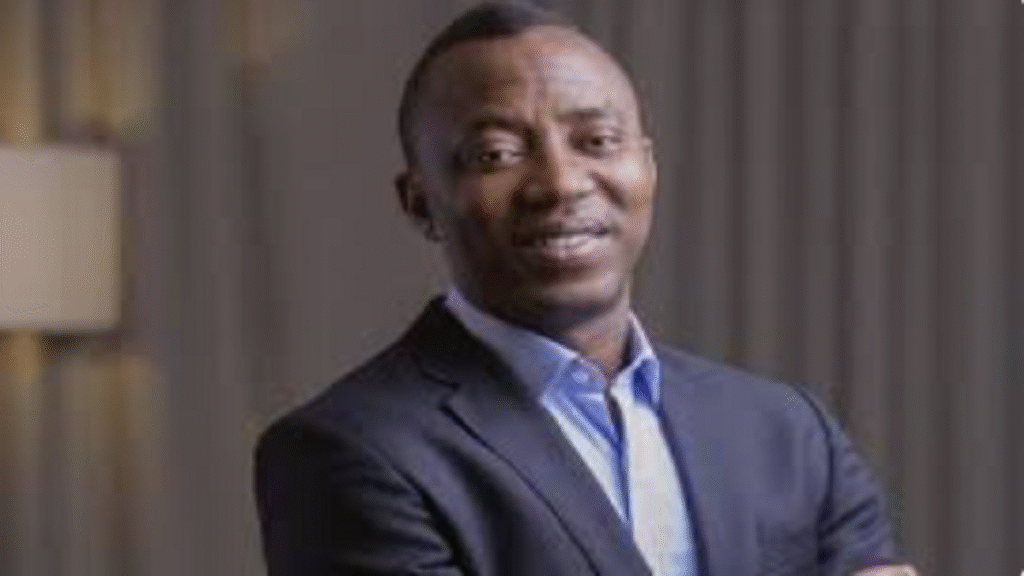
ABUJA, Nigeria – In what appears to be a rapidly escalating standoff, activist Omoyele Sowore filed a counter-suit against Nigeria’s Department of State Services on Tuesday. This came just hours after the federal government hit him with criminal charges for calling President Bola Tinubu a “criminal” on social media. The back-and-forth legal maneuvering may signal a broader clash over free speech in Nigeria’s increasingly digital political landscape.
Government Files Criminal Charges Over Anti-Tinubu Post
Five criminal charges landed on Sowore’s desk at the Federal High Court in Abuja, case number FHC/ABJ/CR/481/2025. The trouble started with his August 25 post on X, where he didn’t mince words: “This criminal @officialABAT actually went to Brazil to state that there is no more corruption under his regime in Nigeria. What audacity to lie shamelessly!”
Director of Public Prosecutions M.B. Abubakar brought the charges under Section 24(2)(b) of the Cybercrimes (Prohibition, Prevention, etc.) Amendment Act, 2024. Interestingly, the government also dragged X and Meta into the mix as co-defendants. Their argument? Sowore’s post was supposedly crafted to “incite public disorder, inflame divisions among Nigerians with opposing political views, and damage the reputation of the President.”
The whole thing kicked off during President Tinubu’s Brazil trip, where he made the bold claim that his administration had wiped out corruption in Nigeria. Sowore’s blunt response clearly didn’t sit well with the DSS, who fired back demanding he delete what they labeled “false, malicious, and inciting” messages. They warned of legal action to “protect national security and public order”, though critics might wonder if protecting the president’s feelings was closer to the mark.
Sowore Launches Constitutional Challenge
Instead of backing down, Sowore doubled down. Working with lawyer Tope Temokun, he filed his own lawsuit aimed at stopping the DSS from pressuring social media platforms to delete his posts. It’s a move that challenges what he’s calling “unconstitutional censorship.”
“These suits were filed to challenge the unconstitutional censorship initiated by the DSS against Sowore’s accounts maintained with Meta and X,” Temokun explained. “This is about the survival of free speech in Nigeria. If state agencies can dictate to global platforms who may speak and what may be said, then no Nigerian is safe.”
Related Posts:
Sowore’s legal team is hanging their hat on Section 39 of Nigeria’s 1999 Constitution, which guarantees freedom of expression. As Temokun put it, “no security agency, no matter how powerful, can suspend or delete those rights.” Whether the courts will see it that way remains an open question.
Broader Implications for Digital Rights
This case could become a real test for Nigeria’s digital rights under the 2024 Cybercrimes Amendment Act. Civil society groups have been raising red flags about the legislation, arguing it hands the government too much power to silence online political criticism. Their concerns may be proving prescient.
Sowore’s lawsuit is asking for some pretty sweeping declarations: that the DSS has no business censoring Nigerians on social media, that Meta and X shouldn’t let their platforms become “tools of repression,” and that constitutional rights need protection from “unlawful interference.”
Temokun didn’t pull punches when addressing the tech giants: “Meta and X must also understand this: when they bow to unlawful censorship demands, they become complicit in the suppression of liberty. They cannot hide behind neutrality while authoritarianism is exported onto their platforms.”
Legal Battle Ahead
By Tuesday evening, neither case had been assigned to a judge. The parallel lawsuits will likely help determine whether Nigeria’s cybercrime laws can be weaponized against political criticism, and whether international social media companies will cave to government pressure.
Throughout this whole mess, the African Action Congress founder hasn’t budged from his position. He’s maintained that criticizing government leaders is a “constitutional duty to hold leaders accountable.” Even with legal threats hanging over his head, he refused the DSS demand to walk back his comments.
“We call on all lovers of freedom, journalists, human rights defenders, and the Nigerian people to stand firm,” his legal team declared. “Today it is Sowore; tomorrow it may be you. This struggle is not about personalities. It is about principle.”
The outcome could set important precedents for digital rights, government criticism, and how international tech platforms navigate Nigeria’s political minefield. Whether this becomes a watershed moment for free speech or another example of government overreach may depend on how willing the courts are to push back against executive pressure.